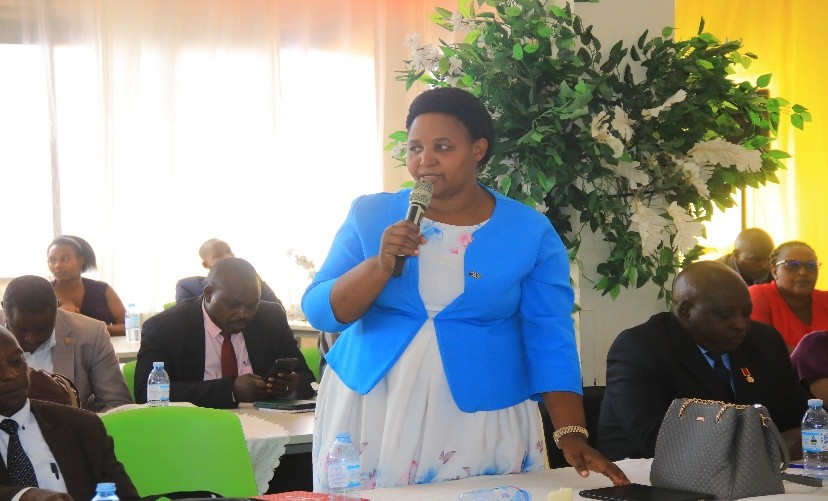


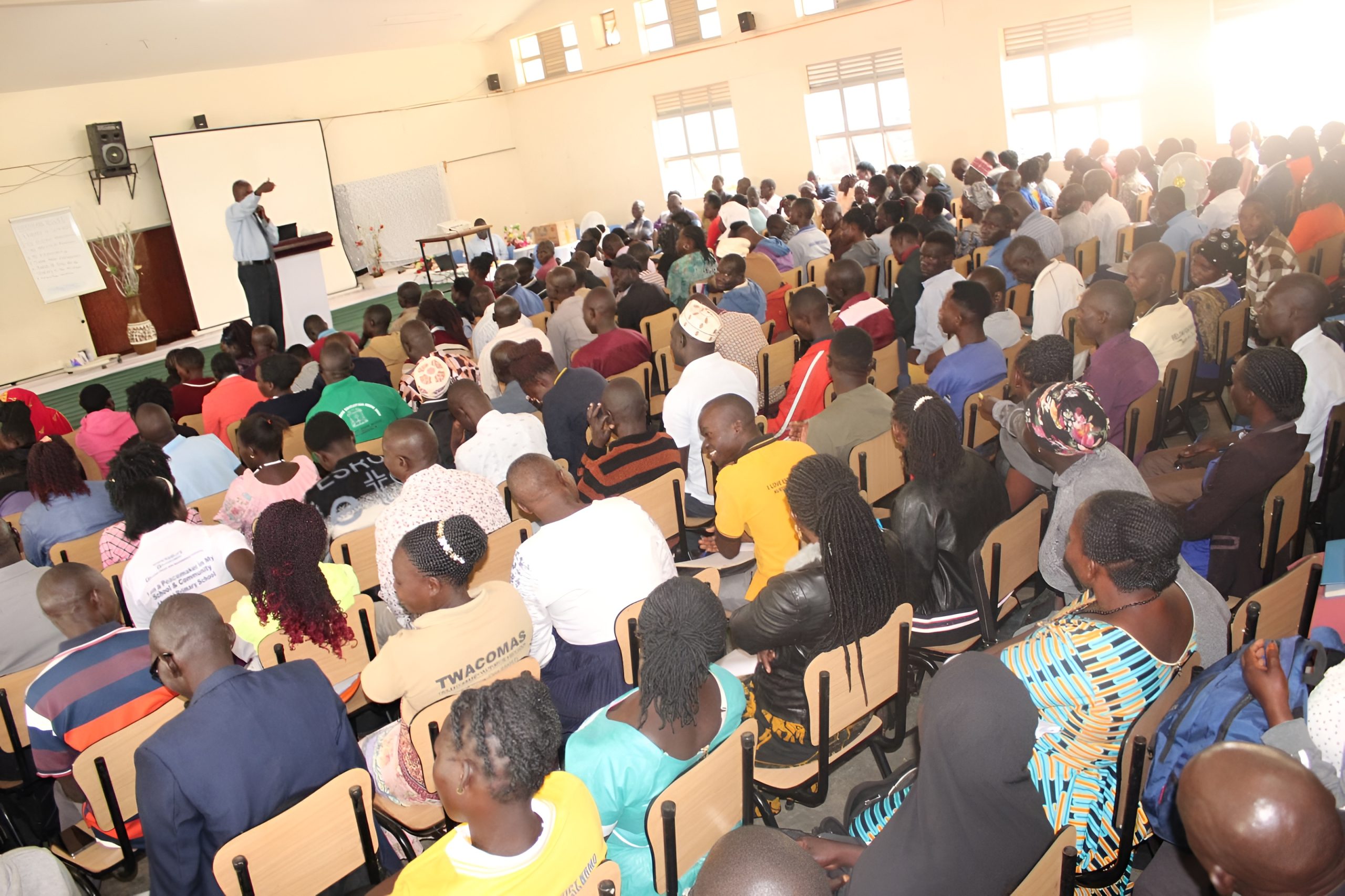

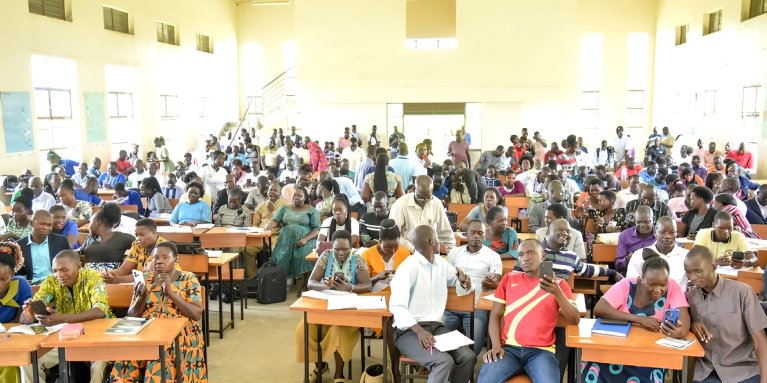




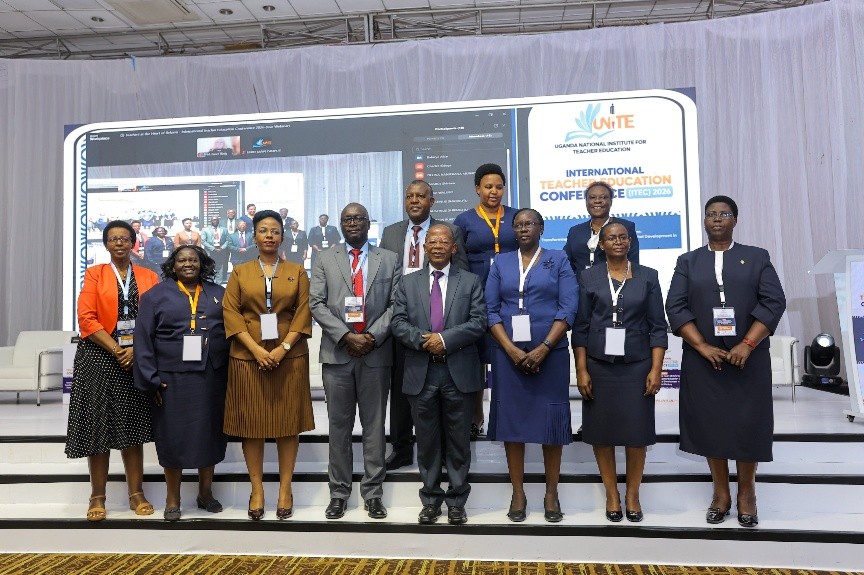
The Uganda National Institute for Teacher Education (UNITE) hosted the inaugural International Teacher Education Conference (ITEC 2026) at Hotel Africana, Kampala, from 30 September to 2 October 2026. The hybrid conference ran under the theme “Teachers at the Heart of Reform: Transforming Teacher Education for Human Capital Development in the 21st Century.” It brought together policymakers, researchers and teacher educators from 16 countries, who met in Kampala for ITEC 2026 and adopted a roadmap for transforming teacher education in Uganda.
The conference received 225 abstracts from 16 countries across Africa, Asia, Europe and North America. After peer review, 162 papers and posters were presented across four sub-themes, alongside two keynote addresses and two plenary panels. A pre-conference workshop on 30 September trained 61 participants in generative AI for teaching and research, competence-based assessment, leadership for reform, and academic writing.
Opening the conference, UNITE Vice Chancellor Prof. Betty Akullu Ezati explained why the gathering mattered now:
“We have gathered here today for a purpose that we believe goes to the heart of this country’s future … to invite Uganda, and indeed the world, into a conversation about the quality of the people who teach our children.”– Prof. Betty Akullu Ezati, Vice Chancellor, Uganda National Institute for Teacher Education (UNITE)

Prof. Betty Akullu Ezati, Vice Chancellor UNITE
She noted that Uganda is one of the youngest nations in the world and that some districts still see teacher-to-pupil ratios of 1:70 or higher. The theme, she said, was chosen deliberately:
“It places the teacher at the centre of conversations on education reform and human capital development, not as a passive recipient of change, but as a critical agent and driver of transformation. Let this be more than a conference. Let it be a platform for meaningful dialogue, a space for learning and collaboration, and a catalyst for ideas and partnerships that can strengthen teacher education in Uganda, across Africa, and beyond.”–Prof. Betty Akullu Ezati, Vice Chancellor, UNITE
Government: reforms are long-term commitments
The Hon. Dr. Chrysostom Muyingo, Acting Minister of Education and Sports, officially opened the conference. He said the theme captures a conviction at the core of government policy:
“Uganda’s future depends, more than anything else, on the quality of the teachers interacting with our children every single day. When we talk about building a skilled and productive nation, the answer always comes back to the classroom, and therein to the teacher.”– Hon. Dr. Chrysostom Muyingo, Acting Minister of Education and Sports
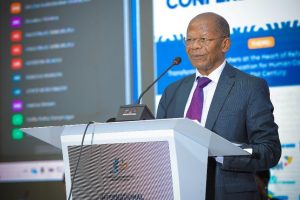
Hon. Dr. Chrysostom Muyingo, Acting Minister of Education and Sports delivering his opening remarks

Hon. Dr. Chrysostom Muyingo, Acting Minister of Education and Sports sharing a light moment with Chairperson UNITE Council and VC UNITE
The Minister listed the steps the government has taken: rationalising teacher training institutions, introducing the competence-based curriculum, establishing UNITE, and setting up a National Teachers Council. He gave delegates a clear assurance:
“Government is not stepping back from this agenda; the reforms put in place are not experiments that will be abandoned when they become difficult. They are long-term commitments, and we intend to see them through.”– Hon. Dr. Chrysostom Muyingo, Acting Minister of Education and Sports
He closed by urging delegates to leave more resolved than ever to keep teachers where they belong: at the very heart of Uganda’s future education system.
UNITE Council: the teacher is the most influential factor
The Chairperson of the UNITE Council, Dr. Robert Ayine, described the founding of UNITE as “a bold and strategic investment in the nation’s future.” Linking the theme to the institution’s motto, “Be the Teacher,” he posed the question at the centre of the conference:
“What kind of teacher do we need for the 21st century? The answer lies in preparing teachers who are innovative, digitally competent, research-oriented, adaptive and committed to lifelong learning.”
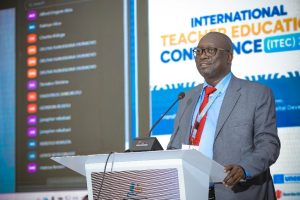
Dr. Robert Ayine, Chairperson UNITE Council during the conference
On the long-running debate over where education spending should go, he was direct:
“While all these are important, the teacher remains the single most influential factor in translating these investments into meaningful learning outcomes.” – Dr. Robert Ayine, Chairperson, UNITE Council
Keynote: teachers as the infrastructure of growth
In his keynote address, Dr. Joseph Muvawala, Executive Director of the National Planning Authority, tied teacher education to Uganda Vision 2040 and the Tenfold Growth Strategy under the Fourth National Development Plan (NDP IV). His central proposition:
“Uganda’s development ambition requires a teacher who can convert schooling into learning, learning into productive capability, and productive capability into higher economic productivity.”– Dr. Joseph Muvawala, Executive Director, National Planning Authority
Drawing on human capital and endogenous growth theory, he argued:
“Teachers are therefore not peripheral to Uganda’s productivity agenda; they form part of the infrastructure through which knowledge, innovation and technological capability are built.”
Dr. Muvawala called for reform across the whole teacher-development value chain: attraction and selection, initial preparation, professionalisation, licensing and conduct, and recruitment, deployment and welfare. He warned that new institutions need matching resources:
“Without commensurate financing, these institutions risk remaining legally established but operationally constrained.”– Dr. Joseph Muvawala, Executive Director, National Planning Authority

Dr. Joseph Muvawala, ED. NPA delivering the Keynote address during the conference
Keynote: lessons from Mary Immaculate College, Ireland
The international keynote came from Prof. Emer Ring, Dean of Education, Early Childhood and Teacher Education at Mary Immaculate College, Limerick, Ireland. Drawing on a century of Irish reform, she showed that systems move from exclusion to inclusion when teacher education, curriculum, pedagogy and assessment are aligned behind a rights-based vision. Reform endures, she said, when it is anchored in legislation, built on research and consultation, and supported by a “wraparound” system around every learner.
Closing: the real conference begins now
Closing the conference on 2 October, Dr. Kedrace Turyagyenda, Permanent Secretary of the Ministry of Education and Sports, praised the quality of the deliberations:
“You have interrogated evidence, challenged assumptions, and brought the lived realities of our schools and training institutions into conversation with the best of national and international research and practice. The Ministry has been listening, and what we have heard matters.”– Dr. Kedrace Turyagyenda, Permanent Secretary, Ministry of Education and Sports
She highlighted three themes: the competence-based curriculum, teacher supply, and artificial intelligence. On AI, she said: “This conference has resisted the temptation to treat AI as a threat. Instead, you have asked the more demanding question: how do we prepare teachers to exercise professional judgement in a world shaped by technologies that are themselves still evolving?”
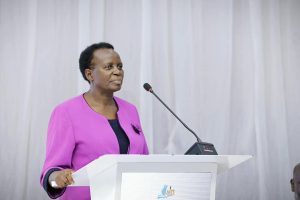
Dr. Kedrace Turyagenda addressing the delegates during the conference
She commended UNITE for convening the event: “To convene an inaugural international conference of this caliber is no small achievement. You have set a standard and the Ministry is proud to stand with you.”
She emphasised that the real conference, the one that matters, begins when delegates return to their institutions, their districts, their classrooms and their policy tables, and that Uganda’s learners are depending on everyone to translate good thinking into better practice.
On 2 October, delegates adopted the Communiqué on Teachers at the Heart of Reform. It was presented by the Chief Rapporteur, Dr. Moses Wambi, and the Conference Convenor, Assoc. Prof. Proscovia Namubiru Ssentamu, Deputy Vice Chancellor (Academic Affairs). The Permanent Secretary confirmed that the Ministry “commits to receiving the communiqué and using it to inform policy review and development.”
Key resolutions include calls to:
- Fast-track regulations for the National Teachers Act, 2026, clearly separating the mandates of UNITE and the National Teachers Council
- Provide UNITE and the Council with adequate, predictable, results-linked financing
- Make teaching more attractive through merit-based selection, a national pre-entry assessment and a clear career path for classroom teachers
- Align initial teacher education curricula with the competence-based school curriculum and strengthen school practice
- Integrate digital pedagogy and the ethical use of AI into all programmes, keeping the teacher’s professional judgement central
- Build a career-long CPD system using the UNITE e-learning platform, mentoring and communities of practice
- Establish a Teacher Education Research and Policy Observatory
What happens next
UNITE will send the Communiqué to the Ministry of Education and Sports, the National Planning Authority, the National Teachers Council and other partners within 30 days. With the Ministry, it will prepare an implementation matrix and report progress at the next conference. Selected papers will appear in peer-reviewed proceedings and a special issue of the UNITE Journal.
ITEC will now be held every two years, with the next edition in 2028.
UNITE appreciates the Ministry of Education and Sports and its partners: The World Bank, Enabel, UNESCO, UNICEF, VVOB, Building Tomorrow, Uwezo Uganda, the Luigi Giussani Foundation, Save the Children, Eight Tech Consults, The African SOUP and Woord en Daad.